More
Japanese tampons:
Anshin
(1977) Tampons, box, directions. ORIGAMI applicator.
(Tambrands gift,
1997) It's the same as Ortex
Gold and Cameo
tampons.
Shampon
Young stick tampon (Japan, 1977)
Instructions for making JAPANESE WASHABLE
MENSTRUAL PADS (early
20th century?), successors of the uma (pony or horse)
See
ads for JAPANESE COMMERCIAL MENSTRUAL
BELTS from the
early 20th century with a discussion of how Japan influenced
European art and vice versa.
Visit the ODOR page.


|

The Museum of Menstruation and
Women's Health
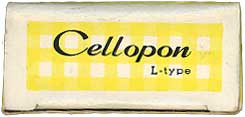
Cellopon
menstrual tampon
(1968, Eisai, Japan)
Because of reasons discussed
below Cellopon seems to be a
Western tampon reworked for the
Japanese market just as the origami
tampon Anshin
(Japan, 1977) was (it's the same
as Ortex Gold
and Cameo
tampons). But I might be wrong.
Mysterious Japan!
The former Tambrands, which
made Tampax tampons, kindly
donated the box and contents as
part of a fabulous gift
of hundreds of menstrual
products.
|
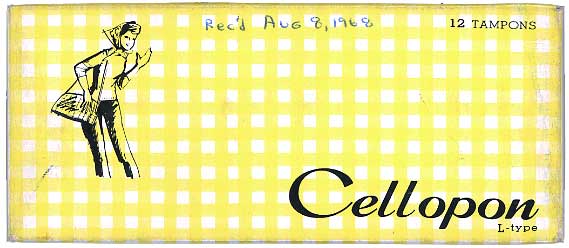
Below:
The cardboard box measures 5 1/2 x
2 1/4" x 1" (13.1 x 5.5 x 2.54
cm).
The box is actually more faded
than the scan shows.
A Tampax
hand at the former
Tambrands company wrote on the
box.
The English words and possibly
Western woman might mean
that this is a Western product for
the Japanese market. But the ways
of Japan are mysterious and it
might not mean that. But what's L-type??
|
 |
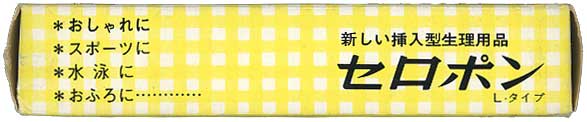
Below:
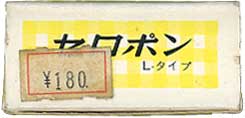
Someone once called Japanese the most
unnecessarily complicated
language in the world.
Here's
part of the reason why: the large, dark type
below is in the Japanese
phonetic
script katakana, which
Japanese use
to reproduce the sounds of
non-Japanese-and-Chinese words -
like Cellopon.
The second character, the square
one,
is actually pronounced somewhat
like RO; Japanese
does
not have a European L sound.
The other Japanese phonetic
script,
hirogana - you can see two
examples right above the left-most
katakana to the right of the end
character (a kanji
character, derived from Chinese,
pronounced SHIN, that means "new")
is used for verb endings and other
grammatical words
or for words the writer prefers
not to write using kanji, the
traditional way to write Japanese.
See why it's
complicated?
|
 |
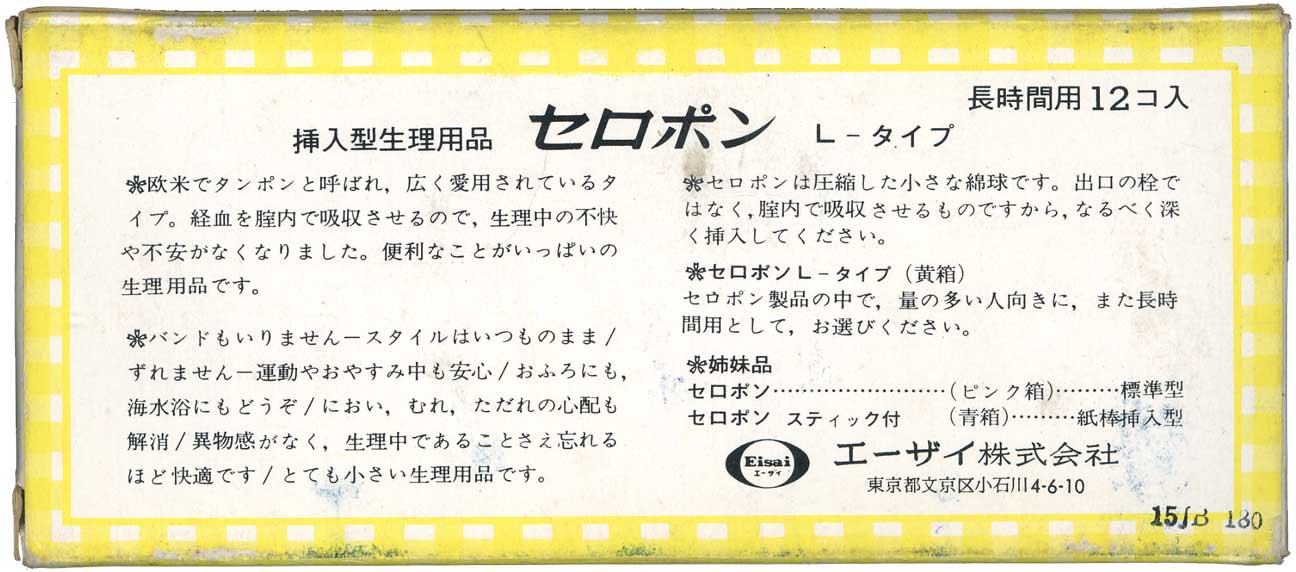
Below:
I hugely enlarged the back
of the box so anyone
knowing the language can
read it. MORE at
right.
|
Right
below: After the
phonetic for Cellopon you
see L
and three phonetic
characters
roughly sounding out the
English word type.
What puzzles me is type
is not translated into
Japanese,
just phoneticized,
suggesting that it was not
important for the Japanese
market but was for
the probably original
English-language market.
|
|
 |
 |
Below
& right: The
ends.
|
The box cost 180 yen. At
this time 360 yen equaled
$1 so the box cost $0.50.
(See
http://www.yen-to-dollar.com)
|
 |
 |
|
© 2008 Harry Finley. It is illegal to
reproduce or distribute any of the work on
this Web site
in any manner or medium without written
permission of the author. Please report
suspected
violations to hfinley@mum.org\
|