In 1995, a woman who read an article about
this museum in the Chicago Tribune newspaper
donated boxes of fax,
Fibs, and other tampons and advertising
material from the 1930s left by her father,
who had worked for Kotex.
In 2001, Procter
& Gamble, owner of Tampax and
Always pads, donated scores of boxes of
tampons and other menstrual products from
the 1930s to the 1960s.
And, of course, the first Tampax AND -
special for you! - the American fax
tampon, from the early 1930s, which also
came in bags.
See a Modess True
or False? ad in The American Girl
magazine, January 1947, and actress Carol Lynley in
"How Shall I Tell My Daughter" booklet ad
(1955) - Modess . . .
. because ads (many dates).


|

MUSEUM OF MENSTRUATION AND WOMEN'S
HEALTH
Tambrands Gives Second Great
Gift to MUM!
Last week [in Nov. 1997],
Tambrands, the former maker of
Tampax tampons, sent this museum four more cases
of duplicate material
they could not take with them to
Cincinnati, Ohio, the headquarters
of Procter & Gamble. P & G
bought Tambrands recently. The
cases contained over 300 packages of
tampons from around the world,
and other material, including
promotional items from its
competitors in the 1960s and
1970s. Together with the material
sent a month ago, Tambrands
has sent MUM over 450
packages of tampons and other
products, plus hundreds of pages
of advertising and related items
and files on rival companies. It's a fantastic
gift! Below are a few of
the items it gave to this museum
last week.
|
|
|
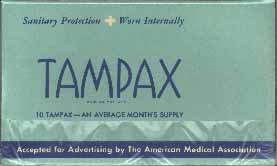
Tambrands marked this package as
being from about 1936, the year
the company started selling
tampons. The company sent MUM an
intact case of twelve unopened
packets, all with cellophane
covering, plus dealers
instructions and extra
instructions for users.
And the donor sent MUM at least
one box of its tampons from every
decade of its existence.
|
|
|
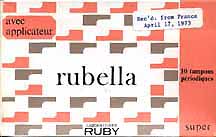
DON'T TOUCH THIS IMAGE! Just
kidding! I show this box from
France because of the name,
medicalese for what Americans call
German measles.
Tambrands sent MUM dozens of
boxes of tampons from France
(including a box of Tampax in
French from 1938), Japan, Finland,
Holland, Belgium, Greece, Italy
and Germany, mostly from the
1970s.
The "rec'd." notice comes from
Tambrands
|
|

|
At left I show tampons
associated with P & G (image
links to Trust;
here is Soft
Shape), including the
ill-fated Rely,
which was involved in the toxic
shock disaster of the early 1980s.
Tampax is its first tampon since
then. A hand at Tambrands wrote on
the boxes.
|
Why "On
the Rag" Means
Menstruation
This e-mail a few days ago
from North Carolina explains
what many women all over the
world have been doing for their
periods for eons:
Hello,
I stumbled over your Web site
and thoroughly enjoyed perusing
it!
My mother grew up in the North
Carolina mountains during the
1920s and 1930s, and there was
no money for any kind of
disposable pads even if they
could find them. She told me
that each girl (or woman) had a
rag collection for use during
her period. You would have
enough rags for three or four
pads. The rags would be folded
together and pinned into
underwear, and later washed and
hung out to dry. Between
periods, they were kept in a
special bag in one's underwear
drawer.
This is the kind of history
that most fascinates me - not
wars, but the little everyday
things that people did and used
to make life more comfortable.
Thanks!
Cathy D. Wahl
The history of daily life is
fascinating, and often
forgotten. One of the reasons I
started MUM was to preserve at
least some of this history.
The black male photographer
for a newspaper that visited
this museum told me that he grew
up in the poorest section of
Chicago in the 1950s. As a boy,
he saw menstrual rags on
clotheslines everywhere. One
"sport" he and his little
friends had was to guess which
women were menstruating. They
thought they could tell by a
bulge, underneath clothing,
between a woman's legs, which
would indicate a rag.
And I never knew
there was such a thing as
menstruation before I was
twelve!
I normally do not use names
of e-mailers, and never without
their permission, but Ms. Wahl
suggested I use hers.
Sweet Secrets
Gets Sweeter!
Last week
in the News I mentioned Sweet Secrets,
a book just published with
stories of menstruation and
material for girls and
adolescents.
Here's a review about it Mary
Beaty just wrote for the
December Quill
& Quire:
Anne
Frank referred to the
onset of her first period as a "sweet secret,"
and anticipated its arrival with
"wonder, joy, confusion and
fear." This new anthology
combines adult reminiscences and
candid adolescent reactions to
menarche and menstruation with
factual explanations and
multicultural and
anthropological data. It covers
the emotional aspects of
menstruation in addition to the
usual sex-and-hygiene-agenda of
health class . . . . This book
builds on ground broken by other
pioneers . . . . This work's
value lies in its friendly
combination of first-person
anecdotes, interviews, and
stories . . . . The
factual information in the first
section is straightforward, and
additional sidebars scattered
among the stories cover sex,
hygiene, cramps, herbal
remedies, and alternatives to
commercial sanitary products . .
. . The book will be a useful
and welcome addition to the
growing body of material on
puberty and sexuality for
adolescent girls and a nice bridge
for discussion with adults.
The impressive list of
contributors includes doctors,
social workers, teen advocates,
and feminist journalists, and of
course the teens who shared
their own experiences . . . .
Read
more about it and the authors!
It's available
at women's bookstores, other
independent bookstores, and most
Chapters bookstores for
approximately $10.99. It is also
available directly from Second
Story Press secstory@fox.nstn.ca
or from Amazon Books Online http://www.amazon.com
Impurity, Infelicity, and Difference of
Opinion
Last week you may have read
the letter in this section
objecting to some thoughts in an
e-mail from Petra Habiger, a
German woman interested in
advising others about
menstruation. Here's the salient
paragraph:
By the way, I think that lady
who said a
woman should answer questions
[in the letter "A subconscious
feeling of being impure" on an
earlier news page] doesn't get
it about your museum. It's not a
doctor's office. There's plenty
of places on the Web for
questions if they're personal,
and if they're not, why not ask
you?
Petra replied,
I am not sure that I really
can understand that woman who
said,
". . . doesn't get it about
your museum. It's not a doctor's
office."
Menstruation in my opinion
does not have so much to do with
sickness. You won't consult a
doctor for questions about
menstruation hygiene.
I think both are saying the
same thing about menstruation,
but they disagree about MY role;
I'm a male and not a doctor of any
kind.
Petra also asked me to change
the headline of my printing of
her e-mail to Questions of
Menstruation and Menstrual
Hygiene, which I have
done. She wrote,
I guess "A subconscious
feeling of being impure" seems
to me a bit infelicitous as a
headline. I can imagine that
women or girls who look for
answers about menstruation and
menstrual hygiene won't be
concerned by a topic about
impurity.
Any comments about this?
Kimberly-Clark Cutting Back
An e-mail friend in Canada - he
was the first to alert me about The Body
Project, a book you must
read - e-mailed me today that
Kimberly-Clark, maker of Kotex and
Kleenex, two icons of America, is
firing about 5,000 workers and
cutting prices because of
competition. K-C might close or
shrink as many as 18 manufacturing
plants worldwide.
I've talked nonstop about
Tambrands recently, which Procter
& Gamble just bought. It is
the end of an icon of American
culture, the company that made the
first tampon with an applicator, a
truly important invention. P &
G will continue the brand name.
Kotex is the other icon in
American menstrual culture, the
first widely successful disposable
sanitary napkin in America; it
first appeared in American
magazine advertising in 1921. One
of the largest displays in this
museum concerns itself with the
early advertising campaign for
Kotex in the 1920s, based on the
collection of papers at the State
Historical Society of Wisconsin.
See what this site has to offer,
too (first
ad,
later ads and Marjorie
May's Twelfth Birthday, the
latter by permission of
Australia's largest museum).
What is interesting is that P
& G makes Always, the
best-selling pad in America, the
main competitor of Kotex. And P
& G already has one icon.
NEXT EARLIER
NEWS
|
© 1998 Harry Finley. It is
illegal to reproduce or distribute
any of the work on this Web site
in any manner or medium without
written permission of the author.
Please report suspected violations
to hfinley@mum.org
|
|