YOUR
remedies for menstrual period pain and
problems. See more remedies here.


|

The Museum of
Menstruation and Women's Health
Former museum–Future–Comic strip about a visit to the museum
Historical
patent medicine for women,
including mail-order cures for
menstruation, cancer, tumors, odor,
insomnia, stomach illness, depression,
birth control, fertility and women's
diseases
Patent medicine, which was
seldom if ever patented, usually
means American "medicines" in
bottles that doctors and others
produced, mainly in the 19th
century, and which sometimes have
a bad reputation: they often
didn't do what they were
advertised to do, such as cure
cancer or banish tumors or cure
problems of the uterus or
menstrual cycle. Many had alcohol
as their main component in a
century of huge alcohol
consumption in America.
In that era some doctors diagnosed
illnesses through the mail
(here
and here),
sometimes encouraging the writer
to visit him or her for further
examination or treatment. And
patients sometimes bought medicine
the doctor created as well as
booklets and advertising devices
designed to spread the doctor's
reputation.
Click on
the following:
Lydia Pinkham's Vegetable
Compound (on this page, right below) -
Cardui
patent medicine - Dr. Grace
Feder Thompson's
letter appealing for patients - Dr. Pierce's
medicines - Dr. E. C. Abbey's The Sexual
System and Its Derangements
(1882) - Dr.
Young's rectal dilators - Orange
Blossom medicine - ad for Ergoapiol
(1904), abortion substance - "Lectures on
Chronic Catarrh" pamphlet
(ca. 1885, by S.B. Hartman, M.D.,
promoting the infamous Pe-ru-na,
Peruna alcoholic medicine)
Midol
pain reliever pills for
menstruation: old tins
(containers), old ads, old
booklet
(selections)
See also
Australian
douche ad (ca. 1900) - Fresca
douche powder (U.S.A.) (date ?) -
Kotique
douche liquid ad, 1974 (U.S.A.) -
Liasan (1)
genital wash ad, 1980s (Germany) -
Liasan (2)
genital wash ad, 1980s (Germany) -
Lysol
douche liquid ad, 1928 (U.S.A.) -
Lysol
douche liquid ad, 1948 (U.S.A.) -
Marvel
douche liquid ad, 1928 (U.S.A.) -
Midol
ad, 1938 - Midol
booklet (selections), 1959
(U.S.A.) - Mum
deodorant cream ad, 1926 (U.S.A.)
- Myzone
menstrual pain pills ad, 1952
(Australia) - Pristeen
genital spray ad, 1969 (U.S.A.) -
Spalt
pain tablets, 1936 (Germany) - Sterizol
douche liquid ad, 1926 (U.S.A.) -
Vionell
genital spray ad, 1970, with
Cheryl Tiegs (Germany) - Zonite
douche liquid ad, 1928 (U.S.A.)
The Perils
of Vaginal Douching (essay
by Luci Capo Rome) - The odor page
(with a surprise or two)
Lydia E.
Pinkham's medicine
business pages on MUM
A discussion
of the letter testimonials,
and their authenticity, of the
Pinkham company (in a discussion
of a Pursettes ad with a letter
testimonial)
See three letters to MUM about
the ingredients
of
her Compound, and one about
the lyrics of an English pop
song,
Lily the Pink, (and parody of
"Yes,
We Have No Bananas" from an American
newspaper) about her.
In 1875, after
her husband went bankrupt, Lydia
Estes Pinkham started probably the
first widely
successful business run by a
woman in America. Her
product was a medicine for "all
those painful Complaints and
Weaknesses so common to our best
female population," meaning mostly
menstruation. Even though Mrs.
Pinkham had been in the temperance
movement, as a student of
phrenology she had studied human
nature, and almost 20% of her
concoction was alcohol,
which she said acted "as [a]
solvent and preservative,"
certainly solving many a problem
and preserving not a few of her
fellow citizens. Many similar
medicines of the past used alcohol
as a main ingredient (Pe-ru-na, Peruna, for example), (continued
below picture)
|
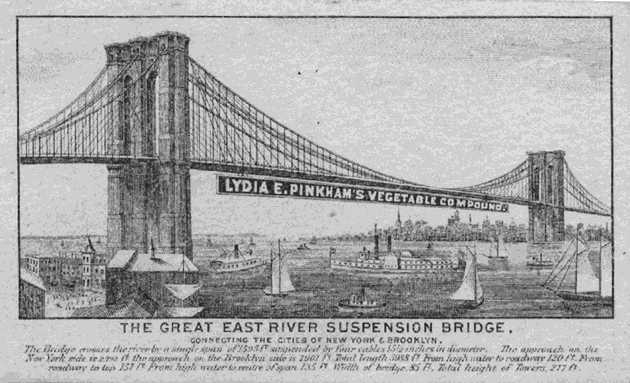
which was often the only way
respectable women were able to
enjoy the intoxicant. And during
the banning of alcoholic beverages
in America, especially in the
1920s, the Pinkham "medicine"
enjoyed its greatest success.
The Brooklyn Bridge decorates a
trade card
(above, 4" x 2.5", 5.1 x 6.4 cm),
black and white) for her product.
Companies advertised their
products on these cards, which
were available free in stores.
Sometimes consumers collected them
and even pasted them into albums.
This card probably dates from the
late nineteenth century (the
Brooklyn Bridge was completed in
1883, the year she died). The sign
hanging from the bridge is as
imaginary as the claims she made
for her compound, which are listed
on the back
of the card. (But read two
objections to my assertion.)
The words below the picture give
some data about the bridge, a
wonder of its day, which is
perhaps what Mrs. Pinkham wanted
Americans to believe about her
cure.
|
The
Schlesinger Library, of the
Radcliffe Institute for Advanced
Study, part of Harvard
University, has probably
the largest
collection of material
about the Pinkham enterprise, the
records of the Lydia E. Pinkham
Medicine Company.
Part of the donation of
SarahAnne Hazelwood to this
museum, much of it patent medicine
and old medical equipment, was a
very interesting biography and
study of Mrs. Pinkham's business,
Female
Complaints: Lydia Pinkham and
the Business of Women's Medicine,
by Sarah Stage.
See two letters to MUM about the
ingredients
of her Compound, and one
about the lyrics of an English pop
song,
Lily the Pink, about her.
Other amazing
women: Nelli Bly, Dr.
Marie Stopes,
Dr. Grace Feder Thompson
See also the patent medicine
Cardui,
Dr. Grace Feder Thompson's
letter
appealing for patients, Dr. Pierce's
medicines, and Orange
Blossom medicine.
© 1999 Harry Finley. It is
illegal to reproduce or distribute
any of the work on this Web site
in any manner or medium without
written permission of the author.
Please report suspected violations
to hfinley@mum.org
|
|