More Midol: Midol ad, 1938
See its competitor from
Kotex, Kurb.
See
Midols ads from newspapers, 1911-1961.


|

Midol
menstrual pain reliever magazine
ads, U.S.A.,
1939, 1948 and 1960 &
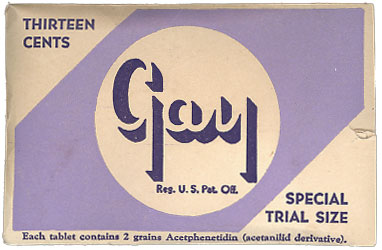
The pain-killer Gay (during and
before the 1940s?)
The woman in the 1939 ad,
below left, can't be picking out
her first Midol pill
because she's already feeling
great - she's smiling! Poor Betty
(far right below, 1960), on
the other hand, hasn't had her
first one yet - but scroll down
and look what happens to her after
she takes a few: she's GAY! But
she's smiling so it can't be that
bad.
The word "Gay" appears in the 1948 ad
but not so personally. And
strangely enough, the closest the
'48 text gets to "menstruation" is
"periodic," whereas the other two
use "menstruation."
There's been a tremendous change
in the everyday meaning of the
word "gay"
in the past 58 years. Midol would
not have dared to use the word if
it had implied homosexuality to
the average person, a taboo
subject then. And I'd bet you a
million bucks they would not use
the word today. But the word did
indeed mean homosexual to some
people in the 1960s and way before
then. The Online Etymology
Dictionary (here)
traces the fascinating history of
the word, which often had
undertones of sex and promiscuity
reaching back to the 19th century.
And it meant "brilliant, showy" as
far back as around 1300.
Not only did Midol make Betty
gay - see the ad below right - but
a whole
brand named Gay made
swallowers gay; see below. Not
necessarily homosexual but happy.
What fodder for the arguments
about the origins
of homosexuality!
After 21 years Midol still
showed an open tin of pills with
one already out. But note that
Betty's "outed" pill - oh, that's
a good one, huh? - doesn't come
from right behind it in the tin
box: there's no space. Why do I
worry about such things?
Midol took care to conceal
menstrual topics; it states that
it will send the reader a booklet
explaining menstruation in a "plain wrapper."
Today people get junk mailings of
menstrual pads and tampons.
See Midols
ads from newspapers, 1911-1961, and two Midol
containers.
I thank the person who
generously sent the scan of the
1939 ad.
|
Below:
Is this drug responsible for lesbians??
How could it be any more explicit?
Even the color is purple. Except
that its only ingredient, acetphenetidin,
is "analgesic,
antipyretic and [has] cardiac
depressant effects"
according to the 1913 handbook
quoted at right. And, of course,
"gay" decades ago meant cheerful
- most of the time (see discussion
at the top of this page).
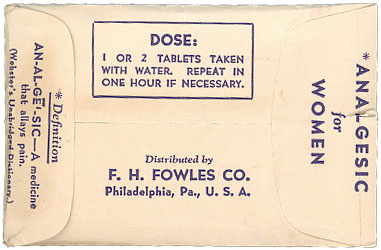
My guess is that Gay was
produced during
or before
the early 1940s because
there is no number code in the
address (which started in the
early 40s) and the logo typography
looks art deco to me, which
flourished in the 1930s.
And the word analgesic
required explanation, which I
don't think would have happened in
the past few decades.
And 13
cents is an oddball price
but maybe not when pennies were
worth a lot more than today.
Once, in first grade, I
found a roll of 50 pennies on
the ground. Oh, boy, I
cashed it in for a huge
amount of candy! Did I tell
anyone? Chicken got teeth?
I won't say what year but a
penny was a penny then.
Lessee, where was I.
Oh: the package, which I didn't
open, contains many pills.
The paper packet measures 2
1/4 x 3 1/2" (5.6 x 8.9 cm).
I thank Procter & Gamble,
which donated this and many
other items from its archives.
|
Below:
The ingredient, acetphenetidin,
"occurs as white, crystalline
scales or a crystalline powder. It
is odorless and tasteless. It is
only slightly soluble in water
(1:925) but soluble in alcohol
(1:12). . . .
"Action and Uses: These are
similar to those of acetanilid,
but it is supposed to be somewhat
safer. Its analgesic, antipyretic
and cardiac depressant effects,
like those of acetanilid, are due
to the formation of
paraaminophenol, and its possible
advantage over acetanilid is
probably due to the fact that this
decomposition occurs more slowly.
It is best administered in the
form of powders,
cachets or capsules.
"Since the enactment of the Food
and Drugs Act, June 30, 1906,
acetphenetidin has frequently
displaced acetanilid as the active
agent in proprietary mixtures for the relief
of headache and other pain.
Its relation to acetanilid
suggests similar caution in its
use.
"Dosage: A full dose is 0.50 gm.
or 712 grains. It is well to begin
with 0.30 gm. or 5 grains, and
repeat every three hours if needed
for a few doses. When small doses
fail to relieve headache, larger
doses are also usually
ineffective." (From A Handbook of
Useful Drugs, 1913,
at
http://chestofbooks.com/health/materia-medica-drugs/American-Medical-Association/A-
Handbook-of-Useful-Drugs/Acetphenetidinum-Acetphenetidin-U-S-P-Phenacet.html
)
|
 |
 |
See more Midol
newspaper ads, 1911-1961,
and excerpts from a Midol booklet, 1959. See
its competitor from Kotex, Kurb.
See Midol tins, 1911-1970s.
|