|


|

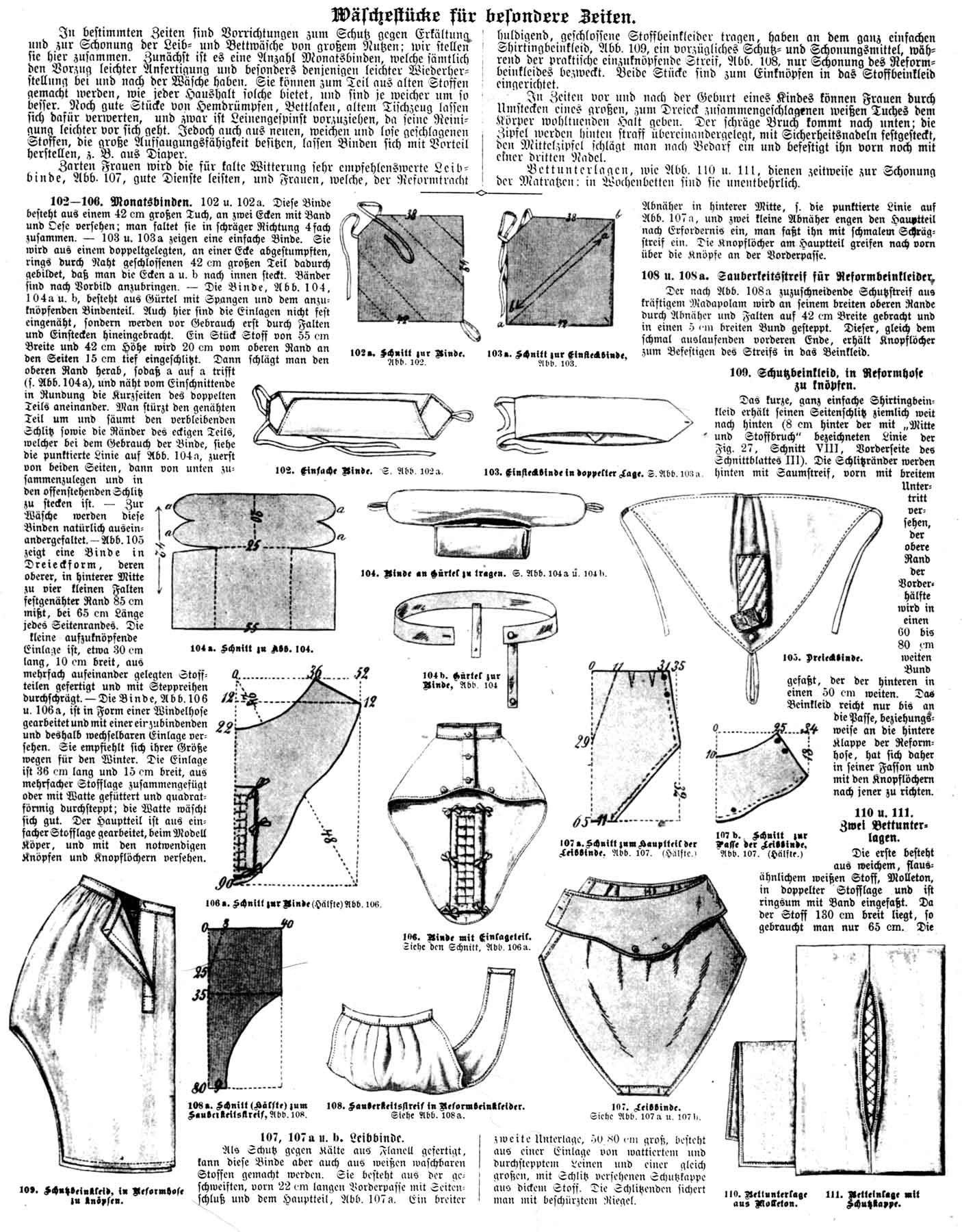
German instructions for making washable menstrual
pads, underpants, menstrual
belts, etc., probably before 1900
Almost everywhere, middle-class
women made much clothing themselves in
the early 20th century and before,
including menstrual
gear,
underwear for cold weather
(in an era when underpants for women
was basically two cloth legs tubes
joined at the waist and open at the
crotch from abdomen to back) and items to protect
themselves and their beds from
vaginal discharge after childbirth
(all of which we see below).
Below is a page entitled "Underwear for
special times" from an
unidentified German publication,
probably from the late 19th century,
giving housewives patterns for
undergarments to be made from scraps
of cloth found in their houses, "the
softer the better." Just as in
America, German women could buy books
of tips for almost every domestic
need, especially in the era before
wide-spread disposable goods and
packaging (read Susan Strasser's Waste and Want: A
Social History of Trash,
1999, Metropolitan Books - buy
it - for a fascinating look at
this). As you can see, Germans are gründlich
- thorough,
both their strength and weakness.
Menstruation
items are illustrations 102-106.
I took the page from Die
Unpäßliche Frau:
Sozialgeschichte der Menstruation
und Hygiene (The Indisposed
Woman: A Social History of
Menstruation and Hygiene), by Sabine
Hering and Gudrun Maierhof
(Centaurus-Verlagsgesellschaft,
Pfaffenweiler, Germany, 1991). The
book is a gold mine of information
about German medical and menstrual
culture.
I made the page so big to be mostly
readable for those who can read
German, in spite of the Fraktur, the
hard-to-read style of type in which
the Germans periodically published
their books, newspapers and magazines,
the last time during the Hitler era,
when it was considered more
"authentic" for Germans than Roman
script. I never had to master the
handwriting of that time - I once did
graduate study in German - but it
correlated somehow with the Fraktur,
and I have heard Germans, including my
brother's mother-in-law, who learned
it in school, chuckle at it.
|
|
© 1999 Harry Finley. It
is illegal to reproduce or
distribute work on this Web site in
any manner or medium without written
permission of the author. Please
report suspected violations to hfinley@mum.org
|
|