See more ads for
menarche-education booklets: Marjorie
May's Twelfth Birthday (Kotex, 1933), Tampax tampons (1970, with
Susan Dey), Personal
Products (1955, with Carol Lynley), and
German o.b. tampons
(lower ad, 1970s)
And read Lynn Peril's series
about these and similar booklets!
See more Kotex items: First ad (1921) -
ad 1928 (Sears and
Roebuck catalog) - Lee
Miller ads (first real person in
amenstrual hygiene ad, 1928) - Marjorie May's Twelfth
Birthday (booklet for girls, 1928,
Australian edition; there are many links here to
Kotex items) - Preparing
for Womanhood (1920s, booklet for girls;
Australian edition) - 1920s booklet in Spanish
showing disposal
method - box
from about 1969 - "Are
you in the know?" ads (Kotex) (1949)(1953)(1964)(booklet, 1956) - See
more ads on the Ads for
Teenagers main page


|

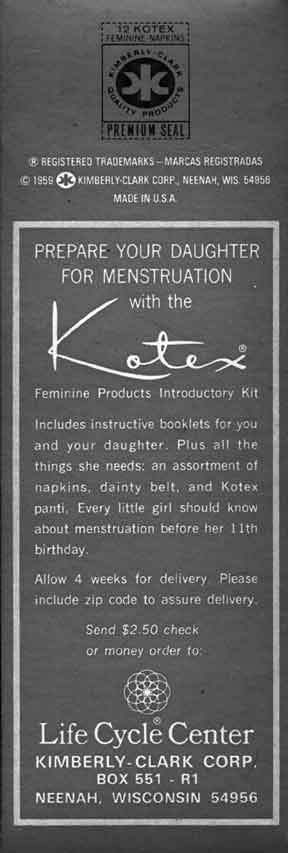
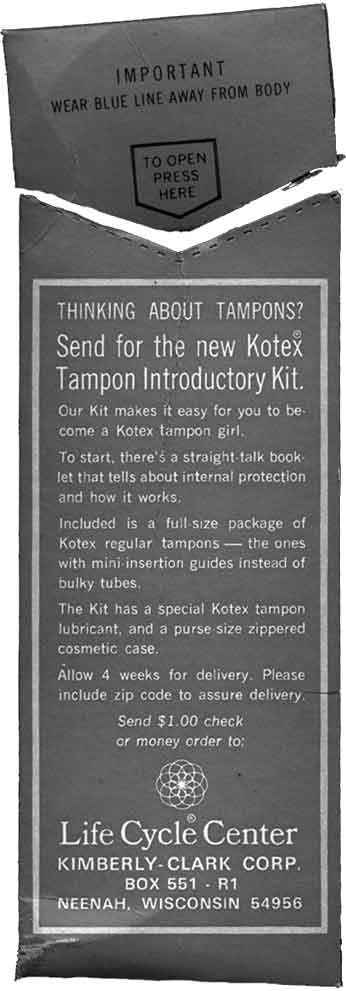
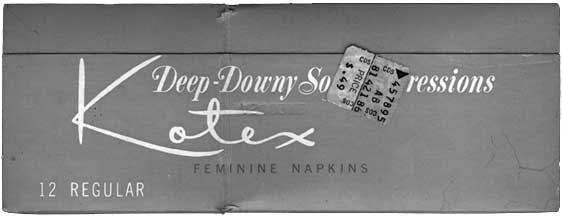
Kotex box and menstrual pad,
probably mid 1960s (U.S.A.)
Box, below
Kotex seems to have abandoned some
of the suggestions from Dr. Lillian
Gilbreth about pad packaging by
the time this box appeared - for
example, the injunction against words
everywhere. Maybe women cared less
about concealment by the 1950s. But
then Dr. Gilbreth directed her
comments to Johnson & Johnson, not
Kotex,
This pad, of course, was designed
for a belt,
as self-adhesive pads didn't appear
until the early 1970s (for example,
Kotex's New
Freedom).
The box bears such a white rose!
C'mon now, aren't most roses red?
Gosh, might a red one - a rose-colored
one! - remind people that these pads
absorb blood? Menstrual
blood? (See a cup-shaped
tulip advertising a menstrual
cup.) A German company famously used a
red camelia on
its boxes to indicate menstruation;
there's more to
the story than just that!
Aside from the color, most American
woman want to wind up smelling like a rose,
not menstrual blood! But at least at
times in the past - and maybe today in
places - women
allowed others to smell and see her
menstrual blood as a sign of
fertility and to sexually attract
others, as extraordinary this
may seem to most North Americans and
Europeans (and to me just a couple of
years ago). (The English feminist
Selina Cooper writes
[towards the bottom of the page]
about this among English girls in a
cotton mill around 1900, where straw covered the
floor to absorb their escaping blood.)
This
fact lends credence to my suspicion
that many or most women in Europe and
North America prior to about 1900 bled into their
clothing - that is, they did
not use rags or tampons or anything
else to absorb and conceal the blood.
Times sure have changed - why? Read more about
this.
But I digress.
See the pad.
|
See the PAD. |
See Cybill Shepherd appearing in ads
for this pad. See a Kotex pad
probably from the 1930s
and one copyrighted 1974.
© 2001 Harry Finley. It is
illegal to reproduce or distribute any
of the work on this Web site in any
manner or medium without written
permission of the author. Please
report suspected violations to hfinley@mum.org
|
|