See a roughly contemporary
pad, Society, and
a "silent purchase"
ad for Modess, 1928.
Other Modess ads:
1931,"Modess . . . . because"
ads, the French
Modess, and the German "Freedom"
(Kimberly-Clark) for teens.
See a prototype
of the first Kotex ad.


|

The perfect menstrual pad 2 (1 2a 3 4 4a 5):
A college student
designs her perfect one, and how Smith
College students behave
"Report of Gilbreth,
Inc.," to the Johnson & Johnson
Company, 1 January 1927, about how to
improve
the company's menstrual products, especially
with regard to competition with Kotex pads
Gilbreth writes of the response of a Smith
College student who wrote about her dream pad.
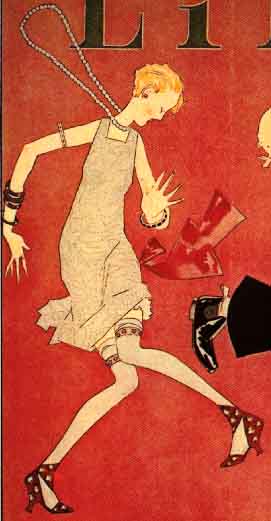
"College
Girl" (see the column at right)
wanted the popular artist John Held, Jr.,
to
illustrate her INVISOS pad
with "a
typical college girl . . . in .
. . a close-fitting party dress
whirling around at a dance. The
John
Held
variety of illustration would be
recommended." Held
painted a cover (a section is
above) for the humor
magazine Life,
18 February 1926, about a year
before the Gilbreth report
appeared, and maybe at the time "College Girl" invented her
dream pad.
|
Her "College Girl" invented the
"INVISOS"
- invisible,
of course, under tight clothing, a
great concern of the women
interviewed (see the column to the
left).
Most pads of the day were much too big
for students' clothing - Kotex,
Curads and Venus #5 were 3 feet or
more long, tab end to tab end
(almost a meter), the absorbent filler being 2
feet long in the Modess
(about 61 cm).
And many students and business
women shortened
the
front tabs holding the
pad to the belt - the back one had
farther to go (see why
and see one
in place) - and pushed around
the pad filler to fit it better.
Square ends
on the filler rubbed the skin;
many women cut them round with
scissors. Some women used petroleum jelly
to coat the edges of pads having
coarse gauze to reduce chafing.
The
student describes her INVISOS:
"This dainty package contains
twelve napkins of a new size so
that one may feel perfectly safe
and comfortable while wearing
them and yet be unhampered. The
day of the bungling, home made
variety is past. The modern girl
cannot be bothered by anything
cumbersome. . . .
"INVISOS are shaped to meet
your needs, offer you complete
security and a knowledge that
you are perfectly well-groomed
and neat regardless of your
dress, activity, or company.
"The
picture accompanying this
should illustrate a typical
college girl . . . in . . . a
close-fitting party dress
whirling around at a dance.
The John Held variety of
illustration would be
recommended." (See
the illustration and caption
at left.)
Bonus just for you: in this
flapper era a ponzi scheme
(according to the New
York Times) arose in 1922
called the Shifters,
which involved flapper-age
people - young, that is - and
had its own vocabulary;
a Shifter would call the dress
of the dancing flapper at left a
knee
duster.
|
Students at Smith College
responded most, by far (at least
436 filled out questionnaires)
Smith students (Smith College,
where poet Sylvia Plath studied
almost three decades later, is in
Northampton, Massachusetts) were
all female, and they chose Kotex
over the others (as Gilbreth says
students also did at the
University of California and Johns
Hopkins University), mainly
because it was
well
advertised (Kotex
marketed its pads with amazing
gimmicks at this time, including
store-window-decoration
contests with big prizes)
and because of its
"average"
size, which seems to
contradict what the author put
in her tables (some figures,
above); but the girls could and
did open up the Kotex gauze and
push the filler around to make
themselves more comfortable.
It was availability,
however, the survey found to be
the most
important factor in
women's buying pads. If it was
there, they would buy it. And
Kotex was the most available.
Kotex ads, as I discovered,
predominate in magazines of the
mid 1920s, and Gilbreth comments
that the girls' college rooms were
strewn with magazines, which they
examined very critically,
especially ads directed at them.
(Kotex aimed this ad
right at college girls.)
Even though the boxes
were always wrapped with paper to
conceal them when they bought them
- children of druggists who
visited the physical
museum MUM told me that as
kids they helped their parents
wrap them - the size and shape
were so well known that "anyone carrying
a box comes in for much humor
and taunting and this is
accordingly not a pleasant
feature of the napkin."
(Continued below the pictures.)
|
|
|
Picture
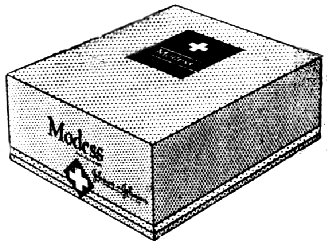
below: This improved box
is from a post-Gilbreth
report ad.
There is little writing,
and at least one side is
blank, letting women store
it with that side
showing, making
it supposedly anonymous.
Note that both Kotex and
Modess used crosses;
other brands did
too.
|
 |
|
Gilbreth found that companies
printed too
many words on the boxes
and they were usually too large,
which could give them away as
menstrual products.
Not one
respondent kept empty boxes
of menstrual pads.
"Hell, no!"
replied one girl when asked if she
did.
Another wrote ironically, "I use
them to send Christmas presents."
The girls' favorite "box"
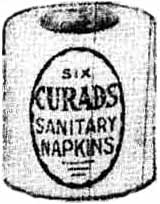
was for Curads (below,
left, and see ad,
1920), which was no box at all,
but a roll
of connected pads that got smaller
as they used them and finally
disappeared.
|
|
|
The
disposable pad Curads, left, came
in a roll,
making it the respondents'
favorite "box," because it wasn't
one. (From an ad in the Sears,
Roebuck catalog, fall 1921)
|
The
girls - Gilbreth often uses this
word - didn't care about disposability
at Smith, normally a huge problem
for Kotex, which
advertised them as flushable
and stuck instructions
into each box about how to do
this. But few women bothered to
take out the filling, rip it in
half, tear the gauze covering
apart, and then soak the filling
in the toilet before flushing the
parts, as directed; who would?
(See more supposedly flushable
pads.)
One student reported the
humiliation of stopping up
the toilet of the family of
her boyfriend with
a Kotex pad after a
football game. She was
eating dinner with the family
when the father noticed a stain
forming on the ceiling and had
to run upstairs to investigate,
finally calling a plumber, a
story similar to those in
columns of "My Most Embarrassing
Moment" in women's and girls'
magazines today.
When they visited
boys' colleges for social
events,
"[t]hen, if ever, . . . [Smith
girls] would dispose of Kotex
down the toilets. But knowing
that this is not successful they
are forced to wrap them and
conceal them until they can
leave the houseparty. As a
result many are forgotten, and
there is embarrassment for both
the men and the women."
By the way, the author reported
that the head nurse, Miss Harris,
in the dispensary of the
Metropolitan Life Insurance
Company, who decided which pads
and machines the 7,000 "girls" in
her company should use - they used
4,500 pads a month dispensed only
through machines - chose the
machine [and its
associated pad, the Hygienic
fiber pad] that would
withstand slugs - fake coins -
and damage caused by the women
using paper cutters and similar
things to push down the releases
on the machines. That
eliminated Kotex and its machines,
which couldn't take it. (See some
early
vending machines and a 1920s
ad for the
early Kotex dispenser - also
1930s Modess
and Kotex
pads for vending machines.)
Miss Harris also found Kotex
unsatisfactory in other ways:
"No girl is taken in to the
employ of the company who has
any menstrual trouble [!], but
if trouble develops after the
girl comes in, they find the
cause and remedy it [!!]. In
this way they learned that Kotex
was irritating to the skin. . .
. [F]ew of
the girls would read the
complete instructions [for
disposing of it], and
fewer would take the time to
follow them. They had a
great deal of trouble with
plumbing [because of Kotex]."
The Smith students preferred to
buy from a woman clerk, which
meant they didn't patronize the
"College Drug Store" and local
shops but made a "weary trip" to a
department store. Kotex solved
this problem in some stores where
customers picked boxes from the tops of
counters, putting money into
a coin box.
© 2000
Harry Finley. It is illegal to
reproduce or distribute work on
this Web site in any manner or
medium without written
permission of the author. Please
report suspected violations to hfinley@mum.org
|
|